



Shopify
Shopify Canvas is Live: What It Can Handle and What It Cannot
Nikki Kumari|Oct 6, 2026|Read 8 Min



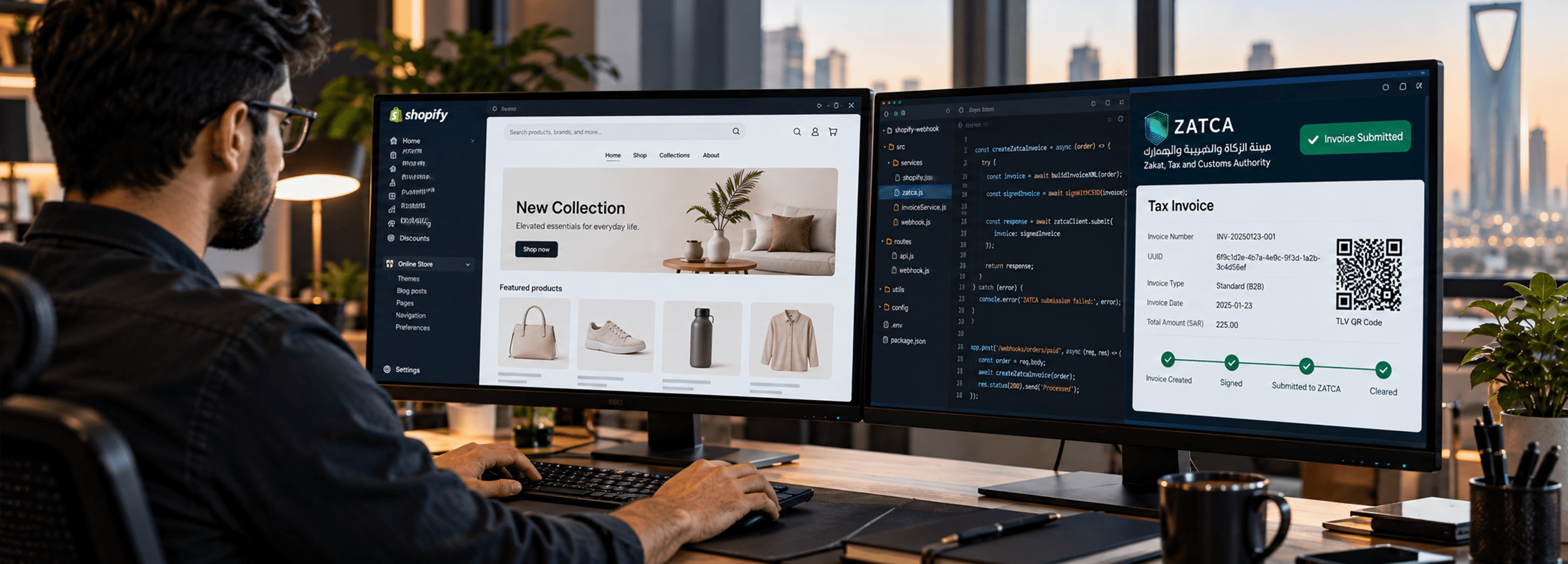
Saudi Arabia's ZATCA Phase 2 e-invoicing mandate is no longer a concern for large enterprises. Wave 25 has announced that July 24, 2026, marks the start of the Integration Phase for every VAT-registered business with revenues above SAR 187,500, with a February 1, 2027 deadline. Compliance is not built in for Saudi eCommerce businesses on Shopify. Shopify does not natively connect to ZATCA's Fatoora platform. The integration must be built outside the platform through a certified solution.
This guide covers what ZATCA Phase 2 integration for Shopify involves, the edge cases, and what to confirm before starting.
ZATCA Phase 2, known as the Integration Phase of Saudi Arabia's Fatoora e-invoicing programme, requires VAT-registered businesses to connect their invoicing systems directly to ZATCA's Fatoora platform. This is beyond a platform feature and is a government compliance mandate. For most eCommerce platforms in Saudi Arabia, this integration is handled natively. Salla and Zid both connect directly to Fatoora. Merchants on those platforms configure their settings and the compliance layer runs automatically.
Shopify is different, as it is a global commerce platform built for international selling. Its invoicing architecture handles VAT calculation, order management, and multi-currency selling across global markets. However, ZATCA Phase 2 requires real-time API integration with a Saudi government platform, cryptographic invoice signing with an ECDSA certificate, and UBL 2.1 XML invoice generation, which are not provided natively.
According to compliance requirements, Shopify merchants in Saudi Arabia must connect Shopify to a ZATCA-certified e-invoicing solution that handles Fatoora integration.
ZATCA's Integration Phase operates in two modes and every Shopify merchant in Saudi Arabia uses both.
Clearance Mode applies to B2B standard tax invoices. When a business buyer places an order using their VAT registration number, ZATCA must cryptographically clear the invoice before it is legally issued to the buyer. The buyer cannot receive the invoice until Fatoora stamps it.
Reporting Mode applies to B2C simplified tax invoices. The invoice is issued to the consumer at the point of sale and reported to Fatoora within 24 hours.
Every ZATCA-compliant invoice must meet five technical requirements: UBL 2.1 XML format, ECDSA cryptographic stamp using a ZATCA-issued CSID certificate, a UUID generated at invoice creation, a nine-tag TLV QR code including the invoice hash and digital signature, and a live API connection to Fatoora for clearance or reporting.
The checkout must detect buyer type automatically. A TRN field at checkout is the standard trigger. B2B orders route to clearance mode. B2C orders route to reporting mode. Routing a B2B order through the B2C path is a compliance defect.
ZATCA rolls out Phase 2 in waves based on annual VAT-taxable revenue:
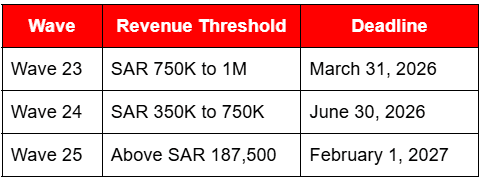
Wave 25 covers businesses whose VAT-subject revenues exceeded SAR 187,500 in any of 2022, 2023, 2024, or 2025. February 1, 2027 is the Wave 25 deadline specifically, not a universal deadline. Businesses in earlier waves that are not yet integrated are already non-compliant, whereas non-compliance carries penalties up to SAR 50,000 per violation.
Shopify does not natively support ZATCA, but it is a proven architecture that connects Shopify to a certified invoicing engine via payment webhooks.
When a customer pays, Shopify fires an orders/paid webhook→The webhook handler posts the order payload to a ZATCA-certified invoicing engine→The engine builds the UBL 2.1 XML invoice, applies the cryptographic stamp using the store's CSID, generates the TLV QR code, and submits to Fatoora→The ZATCA acceptance status returns→The buyer receives a compliant PDF by email.
Shopify merchants can follow the three integration approaches below:
The standard integration handles paid B2C orders cleanly. However, ZATCA compliance is won or lost on the scenarios that fall outside that path.
Refunds and Credit notes
A reported invoice cannot be edited or deleted, as every refund requires a credit note. It requires a new signed document referencing the original invoice's UUID, carrying the returned amounts and VAT, which is itself reported to Fatoora. This must be automated from the Shopify refund webhook, including partial refunds.
Cash on Delivery
Invoicing at dispatch for COD orders creates phantom tax liabilities when packages are refused. The clean approach is triggering invoices on delivery confirmation or payment capture. Where dispatch invoicing is operationally necessary, automate credit note generation on the return webhook.
BNPL Through Tabby and Tamara
The customer invoice is for the full order value with full VAT. The provider fee is a separate cost transaction, and excluding it from the customer invoice understates output VAT. This is the most common BNPL compliance error in Saudi eCommerce.
Promo Codes and Discounts
Discounts must be represented inside the invoice XML at line level or as document-level allowances so declared totals reconcile exactly. Applying the discount in the cart but not in the XML is a common cause of Fatoora rejection.
The 24-hour Reporting Window Under Peak Load
During White Friday or BFCM, high order volumes can push the oldest invoices past the 24-hour deadline before the queue drains. The invoicing engine must process asynchronously off the checkout path with offline buffering for Fatoora outages and automatic retry logic.
Before any development begins, confirm these ten items:
As a Shopify Plus Partner operating in Saudi Arabia, Codilar delivers end-to-end ZATCA Phase 2 integration covering invoicing architecture assessment, middleware development, CSID certificate management, Fatoora onboarding, and production validation. Codilar's Shopify Plus development services include the full integration lifecycle from pre-integration assessment through go-live.
ZATCA Phase 2 compliance is not optional for Wave 25 businesses. The February 1, 2027 deadline applies whether the integration is ready or not.
Businesses that start their integration assessment now will have time to complete it, with time for ZATCA onboarding, sandbox testing, production validation, and go-live. A proper integration takes planning. Fatoora onboarding alone takes two to four weeks before development begins. A REST API or custom middleware integration takes weeks or months beyond that, depending on the architecture.
The businesses that wait until Q4 2026 face compressed timelines, limited capacity from ZATCA-certified providers, and the real risk of entering February 2027 without a compliant integration. Non-compliance with a mandatory government requirement carries penalties of up to SAR 50,000 per violation, per invoice.
Complete your ZATCA Phase 2 integration before February 2027? Connect to Codilar's KSA team.
Not natively, as Shopify does not generate ZATCA-compliant signed XML or manage CSID certificates. The standard architecture connects Shopify's payment webhooks to a ZATCA-certified invoicing engine via REST API. The engine builds the UBL 2.1 XML invoice, signs it with the store's CSID, generates the TLV QR code, and automatically reports to Fatoora.
Yes, every taxable sale by a VAT-registered Shopify store must produce a ZATCA-compliant e-invoice. A simplified invoice for B2C orders reported within 24 hours and a standard invoice for B2B buyers that ZATCA must clear before the invoice is issued. There is no volume threshold or exemption for small orders.
Align invoice issuance with delivery confirmation or payment capture where the fulfillment flow allows. Invoicing at dispatch for COD orders creates phantom tax liabilities when packages are refused at the door. Automating credit note generation on the return webhook corrects refused COD orders without manual accounting work.
The 24-hour reporting obligation stands regardless of Fatoora availability. The integration must queue unsubmitted invoices durably and retry automatically with backoff until ZATCA accepts them. An invoicing engine without offline buffering and automatic retries will miss the 24-hour window during outages or peak-load events.
Non-compliance carries penalties up to SAR 50,000 per violation under Saudi VAT legislation. Every unprocessed invoice is a potential violation. ZATCA has offered penalty waiver initiatives in past waves, but these are time-limited and cannot be relied upon as a compliance strategy.

Get tailored technology solutions to scale your retail business online
Request A Quote

Stay ahead with insights, trends, and brand success stories from the world of Digital Commerce.


Level 1, Building 7, Zone A Airport road, Business Gate P.O Box 93597 Riyadh 11683, KSA

DTECH, Techno Hub 1, Dubai Silicon Oasis Authority, United Arab Emirates - Dubai - United Arab Emirates


Codilar Digital Pte Ltd, 68 Circular Road, #02-01, 049422, Singapore

7th Floor, Jupiter Block Prestige Tech Park, Kadubeesanahalli, Bellandur Amtankere, Bengaluru, Karnataka 560103

Satrio Tower, Floor 6, Unit C and D, Desa/Kelurahan Kuningan Timur, Kec Setiabudi, Kota Adm Jakarta Selatan, Provinsi DKI Jakarta
We look forward to hearing from you