


Omnichannel Retail Strategy for 2026: The Enterprise Guide for Connected Commerce


Listen Full Blog Here
Key Takeaways
- »Omnichannel retail is evolving into a connected commerce ecosystem where digital and physical channels work as one.
- »Real-time inventory visibility and flexible fulfillment have become essential for meeting customer expectations.
- »Mobile apps are no longer optional, serving as a key touchpoint throughout the customer journey.
- »A modern omnichannel platform connects inventory, orders, product data, and customer interactions.
- »Omnichannel customer support and post-purchase experiences play a growing role in customer retention.
- »Enterprise retailers that invest in connected commerce infrastructure will be better positioned for long-term growth.
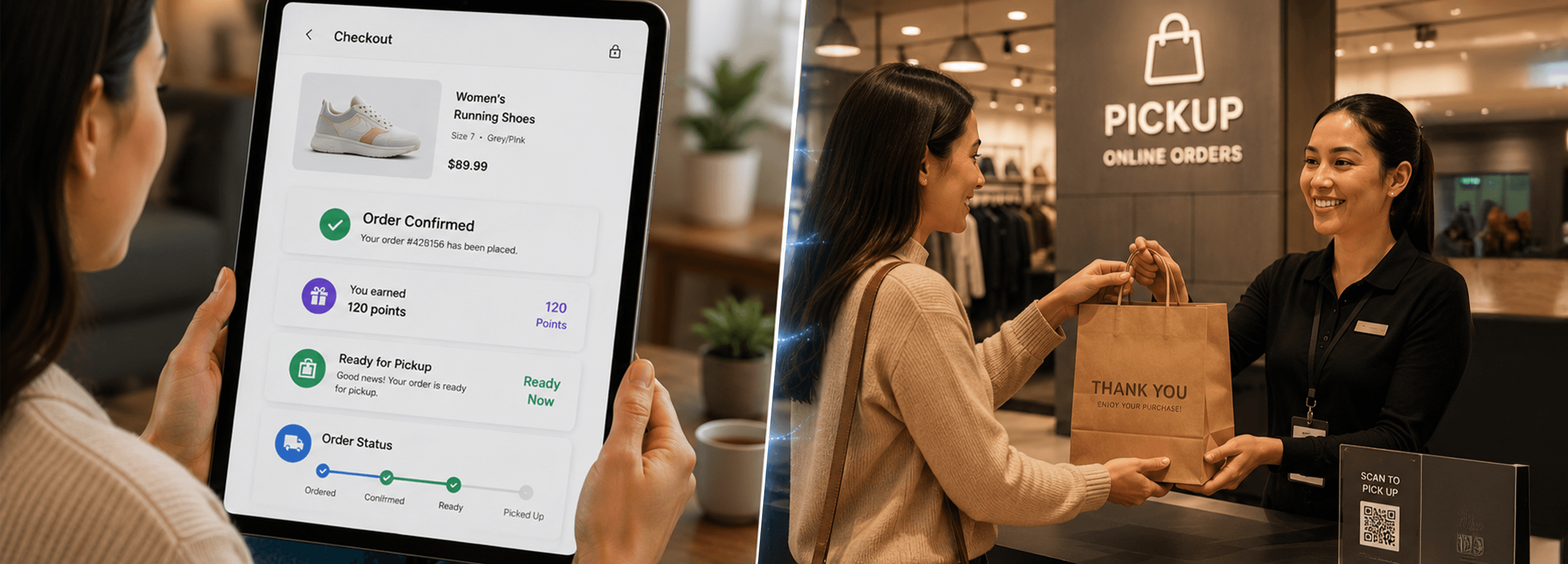
For retailers, omnichannel retail in 2026 is not a strategy to be implemented but an operational model already delivering growth. Shoppers are checking stock online before walking into a store, completing purchases on mobile, and picking up orders the same day. The channel boundaries that retailers once managed separately have collapsed into a single, continuous customer journey.
According to a recent survey of 1,005 online shoppers, this shift has already gone much further than many retailers realize. 97.5% of shoppers had completed at least one in-store or curbside pickup in the past six months, 65.7% checked online for in-store availability before visiting a store, and 34.6% plan to make even more store pickups in 2026 than they did in 2025.
Omnichannel Retail: A New Era
Omnichannel retail is the approach of connecting every channel a shopper interacts with, including the online store, mobile app, physical store, and customer support, into one unified experience. Inventory, orders, customer data, and communication all run from a single connected system so shoppers get a consistent experience regardless of where they engage.
What makes 2026 different is the scale at which this is now happening. Omnichannel is no longer limited to large enterprise retailers with dedicated tech teams. Shoppers across every retail category are using omnichannel services as a default, not a preference.
- 85.9% of top retail chains already offer at least one omnichannel option, and the retailers that do consistently report higher conversion rates than those that do not.
- The omnichannel customer experience has also become a direct revenue driver. When shoppers come in to collect an online order, 26.7% make an additional purchase while they are there.
For enterprise retailers, this era is defined by the commerce platform, inventory, mobile experience, and store operations working as one system. Retailers still managing these as separate functions are not just missing an experience opportunity but leaving measurable revenue on the table.
Top 5 Enterprise Shifts Defining Omnichannel Retail in 2026
Understanding where omnichannel retail is headed starts with understanding what shoppers are already doing today. A survey of over 1,000 online shoppers in early 2026 revealed five clear shifts in how shoppers engage across channels. Each one has a direct impact on how enterprise retailers need to think about their omnichannel platform and the commerce infrastructure behind it.
The physical store is now the last mile of a digital journey
65.7% of shoppers check online for in-store product availability before visiting a store.
Shoppers are not walking into stores to browse, but walking in because your website or app told them the product is there. If your inventory data is not visible online or is not accurate in real time, you are losing foot traffic before it starts. The store visit is the final step of a decision made online.
The retailer app has become the primary omnichannel interface
72.3% of shoppers frequently use a retailer's app for in-store and curbside pickup.
Nearly three in four shoppers are managing their pickup through the retailer's app. The top features they expect are order-ready notifications (53.9%), push or text order updates (42.1%), and the ability to find stores with available stock (32.2%). An app not supporting these will result in lowering the shopper's omnichannel experience.
Inventory visibility is a conversion driver, not a back-office function
42.2% of shoppers say product availability directly determines whether they will place a store pickup order.
Inventory data used to live inside ERP systems, visible only to operations teams. In 2026, it is front-end and revenue-impacting. Shoppers use it to decide whether a store visit is worth making. 15.5% specifically chose store pickup over delivery because they trusted that in-store stock is more reliable. Inaccurate inventory data does not just frustrate shoppers but stops them from converting.
In-store has become a digital touchpoint
30.7% of shoppers used a mobile app to locate a product inside a physical store.
Shoppers are bringing their phones into the store and using them actively. 19% scanned barcodes in-store via mobile to get product information. 16.5% checked themselves out on their own device. 16% used image search to find a matching product on a retailer's app. These behaviors are happening with or without the retailer's support.
Pickup volume is growing
34.6% of shoppers expect to make more in-store or curbside pickups in 2026 than they did in 2025.
Over a quarter of shoppers completed six or more pickups in a six-month period. 13.2% expect to make significantly more in 2026. This is a permanent behavioral shift, not a temporary convenience. Retailers that have not built the omnichannel eCommerce infrastructure to support growing pickup volumes will feel the strain on operations, fulfillment, and customer satisfaction as demand continues to rise.
Building an Enterprise Omnichannel Strategy for Connected Commerce
Most enterprise retailers have adopted omnichannel strategies, yet with hidden gaps across systems, data, and operations often limit their effectiveness. A connected commerce strategy only delivers results when inventory, orders, mobile, and product data are all working from the same source. Here is what each of those pillars needs to look like in practice.
Unified inventory management
Real-time inventory visibility is the backbone of omnichannel retail. With shoppers relying on online stock information before making purchases, connected eCommerce, ERP, and POS systems help retailers reduce friction, build trust, and protect revenue.
A mobile experience built for the full journey
72.3% of shoppers use the retailer app to manage pickup. 30.7% use it inside the store to locate products. The mobile experience is not just a purchase channel but the thread that connects the entire omnichannel customer journey from discovery to fulfillment.
Order management that supports multiple fulfillment models
BOPIS, curbside pickup, ship from store, and cross-location order routing all need to work from a single order management system (OMS). 44.9% of shoppers ordered online and picked up in store and 31.9% used curbside. These are not edge cases. They are mainstream fulfillment paths that your platform needs to handle reliably with accurate status updates at every step.
Centralized product data across every channel
Inconsistent product information across channels is one of the most common reasons omnichannel experiences break down. A centralized PIM ensures that product descriptions, pricing, availability, and images are accurate whether a shopper is on your website, your app, or standing in your store.
At Codilar, we help enterprise retail brands build this infrastructure across Adobe Commerce (Magento), Shopify Plus, and Akinon. The goal is not to add channels but to ensure every channel your shoppers use is powered by the same connected system underneath.
Why Customer Support is Becoming an Omnichannel Differentiator
The customer journey doesn't end at checkout. In omnichannel retail, post-purchase interactions have become a critical touchpoint for building trust, loyalty, and long-term customer relationships.
Customers increasingly expect the flexibility to buy online, pick up in-store, manage returns across channels, and receive timely updates throughout the fulfilment process. According to a recent survey, nearly 45% of shoppers have used BOPIS, while 26.7% make additional purchases during pickup, turning convenience into a revenue opportunity.
- Connected Support Creates Seamless Experiences: Modern omnichannel customer support goes beyond resolving issues. It connects every stage of the customer journey by enabling real-time order tracking and status updates, flexible pickup and return options, consistent customer information across channels, faster issue resolution with unified customer data, and personalized post-purchase communication.
- Post-Purchase Touchpoints Drive Customer Loyalty: Returns and order pickups are no longer just operational tasks. They are valuable opportunities to strengthen customer relationships and encourage repeat business. Retailers are seeing customers engage beyond the initial transaction with 26.7% making an additional purchase while picking up an online order and 18.5% making an additional purchase during an in-store return.
- Building Connected Commerce Beyond the Sale: Enterprise retailers need customer support capabilities that work alongside inventory management, order fulfillment, and customer engagement systems. A connected approach helps brands deliver consistent experiences across channels, reduce friction throughout the customer journey, improve customer satisfaction and retention, create opportunities for repeat purchases, and build stronger, long-term customer relationships.
As omnichannel retail continues to evolve, customer support is becoming more than a service function. It is a strategic part of connected commerce that helps brands deliver seamless experiences from the first interaction to the next purchase.
Enterprise Omnichannel Checklist for 2026
As customer expectations continue to evolve, enterprise retailers need to evaluate whether their commerce ecosystem is built for connected experiences. Use this checklist to assess your omnichannel readiness for 2026.
Inventory and fulfillment
- Real-time in-store stock is visible on your website and app before a shopper visits
- BOPIS and curbside pickup are supported with live order status at every step
- Inventory is synced in real time across your eCommerce platform, ERP, and POS
- Ship from store and cross-location order routing are supported by your OMS
Mobile and app experience
- Your app or PWA sends order-ready push notifications and real-time order updates
- Shoppers can notify the store they are on their way from within the app
- Your app supports in-store product location, barcode scanning, and mobile checkout
Data and Customer Experience
- Product data is centralized via PIM and consistent across all channels
- Online and in-store behavior feeds into a single customer profile via CDP
- Pickup time windows are configurable and communicated clearly at order placement
- Cross-channel returns are supported, buy online and return in store
The Future of Omnichannel Retail is Connected Commerce
Demand for omnichannel services is not leveling off. According to a recent survey by Digital Commerce 360 in 2026, 34.6% of shoppers expect to make more store pickups in 2026 than they did in 2025, and 58.7% expect their volume to stay the same or grow.
The next wave of complexity for omnichannel retail is already taking shape. AI-driven product discovery, conversational commerce, and deeper integrations between platforms like Shopify, Google, and emerging AI search interfaces are changing how shoppers find and evaluate products before they ever reach a retailer's website. Retailers that have already unified their product data, customer data, and fulfillment infrastructure will be able to plug into these channels quickly.
Omnichannel success isn't built overnight, but the right strategy can accelerate the journey. Codilar helps enterprise retailers unify commerce, operations, and customer experiences to create connected ecosystems that drive growth, loyalty, and long-term competitive advantage. Ready to see where your omnichannel strategy stands? Connect with us

FAQs
Omnichannel retail in 2026 refers to a fully connected commerce model in which online stores, mobile apps, and physical stores operate as a single, integrated system. Inventory, orders, customer data, and support are unified to deliver a seamless customer experience across all touchpoints.
Mobile apps have become the central hub of the omnichannel journey. Customers use them to check stock, manage pickups, receive notifications, locate products in-store, and even complete mobile checkout, making mobile a critical engagement and fulfillment channel.
Real-time inventory visibility ensures that customers see accurate product availability before visiting a store or placing an order. It directly impacts conversion rates, reduces failed purchases, and supports key fulfillment models like BOPIS and curbside pickup.
Customer support is a key differentiator in omnichannel retail because it connects the entire post-purchase journey. Features like real-time order tracking, cross-channel returns, and unified customer data help improve satisfaction, increase repeat purchases, and build long-term loyalty.
Modern omnichannel retail supports multiple fulfillment models, including Buy Online Pick Up In Store (BOPIS), curbside pickup, ship-from-store, and cross-location order routing. These models rely on a unified order management system to function smoothly.

eRetail Growth
in Mind?
Get tailored technology solutions to scale your retail business online
Request A Quote


Subscribe to
Stay in Know
Stay ahead with insights, trends, and brand success stories from the world of Digital Commerce.