




Adobe
Adobe Commerce ERP Integration: How to Build it Right
Nikki Kumari|Aug 25, 2026|Read 7 Min




An eCommerce platform should make it easier to grow, not create limitations around growth.
As Saudi businesses expand their digital operations, enter new markets, and manage increasingly complex customer journeys, the platform they started with may no longer meet their needs. Performance issues, limited integrations, outdated technology, and difficulty scaling can all signal that it is time to consider an eCommerce platform migration.
At Codilar, we help businesses plan and execute eCommerce migrations with a focus on business continuity, data accuracy, SEO, integrations, and long term scalability.
eCommerce migration is the process of moving an online store from one eCommerce platform to another. Depending on the business, this can involve migrating products, categories, customers, orders, content, pricing, inventory, SEO data, and integrations.
For a growing business, migration is rarely just about moving data. The new platform also needs to work with the systems that support everyday operations, including ERP, PIM, OMS, CRM, payment gateways, shipping platforms, and marketplaces.
That makes eCommerce replatforming a strategic technology decision rather than simply a website rebuild.
There is no single point at which every business needs to migrate. However, certain challenges are strong indicators that your current platform may be limiting your growth.
You may need to consider migration if:
The goal should not be to migrate simply because a newer platform exists. The right reason to migrate is that your current architecture is preventing the business from moving forward.These signals rarely appear as one big failure. Beyond The Beach migrated from Magento to Shopify after a set of smaller constraints like manual order syncing, legacy data, and slow performance, began compounding.
A successful migration requires planning across technology, data, SEO, integrations, and the customer experience.
We start by understanding the existing eCommerce ecosystem.
This includes the current platform, customizations, product catalog, customer and order data, integrations, SEO structure, business workflows, and technical limitations.
This assessment helps us determine what should be migrated, what should be improved, and what should be rebuilt.
The destination platform should match your business requirements rather than the other way around.
For example, a business looking for a flexible SaaS ecosystem may consider Shopify Plus, while an enterprise with complex B2B requirements, extensive customization, or a specific technology stack may benefit from Adobe Commerce.
We evaluate factors such as scalability, functionality, integrations, total cost of ownership, customization requirements, and future growth before defining the migration approach.The same question can produce two different, correct answers: Reebok moved to Shopify Plus for speed and multi-market agility, while Danube Home stayed on Adobe Commerce for omnichannel depth.
Data is one of the most critical parts of an eCommerce migration.
Depending on the platform and business, this can include:
We map the existing data structure to the target platform, transform data where necessary, and validate it after migration.
EROS moved three live production databases totalling over 36 GB with zero data loss, even after the planned migration route was blocked mid-project.
An eCommerce platform rarely operates in isolation.
ERP, PIM, OMS, CRM, payment gateways, shipping systems, marketplaces, analytics tools, and other applications may all depend on the existing platform.
We review these dependencies as part of the migration so that critical business processes continue working with the new architecture.
Changing platforms can affect organic visibility if SEO is not considered from the beginning.
We account for existing URLs, redirects, metadata, site structure, internal links, and other SEO elements during migration.
Where URLs change, appropriate redirect mapping helps users and search engines reach the correct pages on the new store.
Before going live, we test the complete customer and operational journey.
This includes product discovery, search, cart, checkout, payments, shipping, customer accounts, promotions, inventory, integrations, analytics, and performance.
We also validate migrated data and identify issues before they affect customers.
Migrating an eCommerce store in Saudi Arabia involves more than moving products and customer data to a new platform. The new architecture also needs to support the Kingdom's tax, invoicing, language, and commerce requirements.
ZATCA e-invoicing: Businesses subject to Saudi Arabia's e-invoicing regulations need compliant electronic invoicing solutions. ZATCA's requirements cover invoice generation, required invoice fields, and integration requirements under Phase Two. During migration, we account for how invoices, credit notes, debit notes, VAT information, and relevant invoice data will work on the new platform.
VAT: VAT needs to be correctly reflected across the eCommerce journey, including product pricing, checkout, invoices, refunds, and reporting. Saudi Arabia's standard VAT rate is 15% where applicable, and VAT-registered businesses are required to account for VAT on taxable supplies.
Arabic and bilingual experiences: For businesses serving Saudi customers, Arabic should be considered as part of the storefront and content migration strategy. Product information, navigation, transactional content, and other customer-facing elements may need to support Arabic alongside English.
Local payments and delivery: Payment gateways, BNPL options, shipping providers, and other Saudi-specific integrations need to be assessed before migration. Rebuilding these connections on the new platform helps ensure that customers can continue to use familiar payment and fulfillment options after launch.
Regional operations: Businesses serving multiple GCC markets may also need to account for different currencies, tax rules, catalogs, pricing, inventory, and storefront experiences. A well-planned migration can provide a stronger foundation for managing these requirements as the business expands.
At Codilar, we consider these regional requirements alongside the technical migration itself. This helps us build a commerce architecture that is not only ready for launch but also aligned with how your business operates in Saudi Arabia.
We handled exactly this for Reebok Saudi Arabia, where ZATCA compliance, VAT invoicing, and a localized checkout were built into the Shopify Plus migration, and for LC Official, where Arabic and RTL support was architected rather than retrofitted.
There is no universal migration path. The best approach depends on the existing platform, business requirements, data structure, integrations, and target architecture.
Some migration scenarios businesses may consider include:
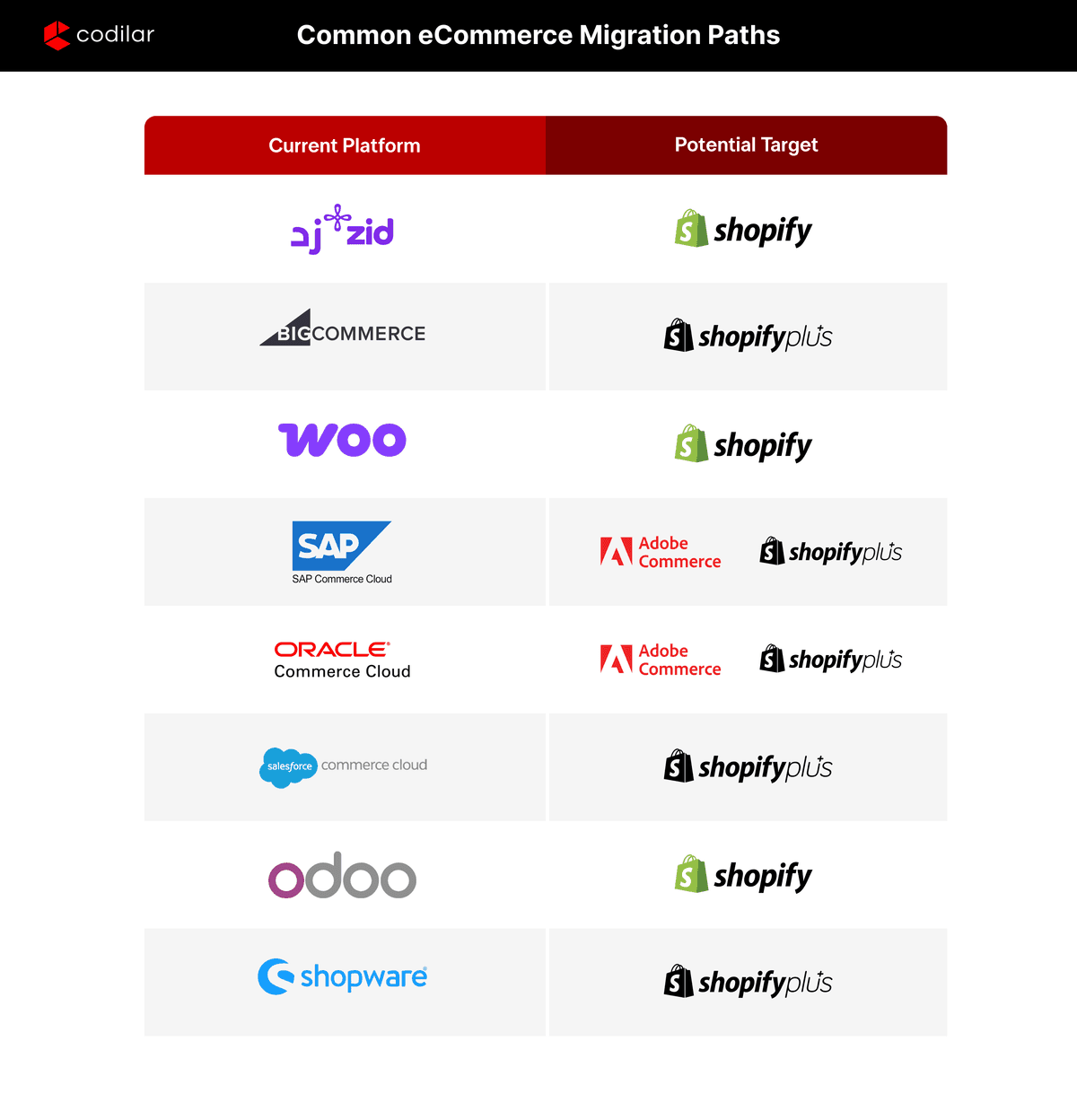
Common replatforming routes for online retailers, from SMB storefronts like Zid and WooCommerce onto Shopify, and enterprise systems such as SAP and Salesforce Commerce Cloud onto Shopify Plus or Adobe Commerce.
Businesses may also migrate from other platforms depending on their requirements. For example, a company moving away from a legacy or heavily customized platform may evaluate Adobe Commerce or Shopify Plus as part of a broader commerce modernization initiative.
The important question is not simply “Which platform should we migrate to?” but “Which platform is best suited to where the business needs to go next?”Read also: BigCommerce to Shopify Migration
Migration projects can become complex when businesses underestimate the dependencies involved.
Common challenges include:
Data complexity: Large catalogs, custom attributes, historical orders, and customer records require careful mapping and validation.
SEO risks: Changes to URLs or site structure can affect organic visibility if redirects and SEO elements are not handled correctly.
Integration dependencies: Existing ERP, PIM, OMS, CRM, and payment integrations may need to be redesigned or rebuilt.
Downtime: Poorly planned launches can disrupt sales and customer journeys.
Custom functionality: Features built specifically for the existing platform may not have a direct equivalent on the new platform.
Business continuity: Teams still need to manage orders, inventory, customer service, and other operations throughout the migration.
A structured migration plan helps identify these challenges before they become launch day problems.
At Codilar, we treat migration as a business transformation project, not simply a platform change.
We bring together commerce strategy, platform expertise, development, integrations, data migration, testing, and post launch support to manage the different parts of the transition.
Our experience across Adobe Commerce, Shopify, Shopify Plus, Akinon, and other commerce technologies helps us evaluate migration requirements based on the business rather than following a one size fits all approach.
For enterprise brands with complex catalogs, B2B requirements, or deep ERP and OMS dependencies, our Adobe Commerce expertise helps us plan migrations that preserve custom functionality rather than compromising on it.
We have delivered commerce transformations for brands including Reebok, Oakley, Foot Locker, ALDO, Ajmal Perfumes, Danube Home, Marina Home, Carter's, EROS, and Beyond The Beach across KSA, the UAE, the wider GCC, and international markets. Explore the full portfolio.
A successful migration should leave you with more than a new storefront. It should give your business a commerce platform that is easier to scale, integrate, manage, and evolve.
If your current platform is becoming a barrier to growth, we can help you evaluate your options and build a migration strategy around your business goals.
Talk to Codilar about your eCommerce migration in Saudi Arabia.
A short dip is common. A permanent loss is not, and it is almost always caused by one thing: incomplete redirect mapping. Industry data suggests a large share of pages that lose rankings after a badly executed migration never fully recover them, which is why URL mapping should begin during the assessment phase rather than the week before launch. We built an SEO-safe redirection strategy into the Reebok migration specifically to protect existing rankings through the cutover.
Order history, customer accounts, addresses, and loyalty balances can all be migrated, and they should be. Customers who cannot see their past orders lose trust in the new store immediately. Passwords are the exception. Platforms hash passwords differently, so in most migrations customers will need to reset on first login, which is worth planning a communication around before launch.
The timeline depends on catalog size, data complexity, customizations, integrations, and the target platform. A straightforward migration can take a few weeks; a full enterprise replatforming with ERP integration and custom functionality typically runs several months. As a reference point, the Arabic localization and storefront rebuild for LC Official was delivered in five weeks, while multi-market replatformings with compliance and integration scope sit at the longer end.
They get rebuilt, replaced with an equivalent, or consciously dropped, and deciding which happens during assessment, not after launch. Beyond The Beach had virtual try-on, staff discounts, and loyalty point redemption on Magento. None of these exist natively on Shopify, so each was rebuilt from the ground up using Shopify Functions, Checkout UI Extensions, and third-party integrations.
It should not. A zero-downtime cutover relies on validating the new environment in parallel with the live one, reducing DNS TTLs ahead of the switch, shifting traffic incrementally rather than all at once, and keeping a tested rollback path available throughout. That is how we moved Veppy to a new architecture with zero downtime while it was handling over 37 million CDN requests a month.
Not out of the box. VAT-registered Saudi merchants on international platforms need a compliant e-invoicing solution integrated into the commerce stack, covering invoice generation, required fields, and the integration requirements under Phase Two. This is best scoped as part of the migration rather than added afterwards. For Reebok KSA, custom ZATCA invoicing compliance and VAT-compliant invoice generation were built into the Shopify Plus migration itself.
Whenever you are not about to face a peak. Ramadan, Eid, and White Friday are the wrong weeks to test a new checkout, and a migration that lands in October has very little room to recover before the season. Working backwards from your quietest trading window, and leaving a stabilisation period after launch, matters more than the calendar date itself.

Get tailored technology solutions to scale your retail business online
Request A Quote

Stay ahead with insights, trends, and brand success stories from the world of Digital Commerce.


Level 1, Building 7, Zone A Airport road, Business Gate P.O Box 93597 Riyadh 11683, KSA

DTECH, Techno Hub 1, Dubai Silicon Oasis Authority, United Arab Emirates - Dubai - United Arab Emirates


Codilar Digital Pte Ltd, 68 Circular Road, #02-01, 049422, Singapore

7th Floor, Jupiter Block Prestige Tech Park, Kadubeesanahalli, Bellandur Amtankere, Bengaluru, Karnataka 560103

Satrio Tower, Floor 6, Unit C and D, Desa/Kelurahan Kuningan Timur, Kec Setiabudi, Kota Adm Jakarta Selatan, Provinsi DKI Jakarta
We look forward to hearing from you