




General
StyleSmuggler (CVE-2026-75650): Security Alert for Adobe Commerce and Magento Open Source Stores
Nikki Kumari|Sep 15, 2026|Read 5 Min




Someone buying cosmetics online cannot test a lipstick shade against their lips or check how a foundation matches their skin. Beauty brands have to convince someone to trust a product they have only seen on a screen.
This is the toughest challenge in building a beauty eCommerce website in Saudi Arabia, and it is also where the real opportunity is.
Most beauty discovery in Saudi Arabia now happens online. The country has one of the highest social media usage rates in the world, and most beauty discoveries happen on Instagram and TikTok first. A brand without a website is invisible at the exact moment a customer is deciding what to try next.
The Saudi beauty and personal care market is projected to grow past USD 10 billion by 2031, according to Mordor Intelligence, and online retail within that category is growing faster than the category as a whole. This growth is driven by near-universal mobile use and a population where over 60% is under the age of 30.
eCommerce has also stopped being optional for a structural reason. Saudi Arabia has been rapidly building out a cashless payment infrastructure, from mada to Tabby and Tamara, alongside a regulatory environment, from ZATCA e-invoicing to SFDA product registration, that treats digital commerce as the default channel.
So, a beauty brand staying offline in Saudi Arabia is working against the direction the entire market is being steered toward.
A shopper doesn't decide to buy a beauty product in one moment. They move through four stages, and a website that gets all four right earns the sale.
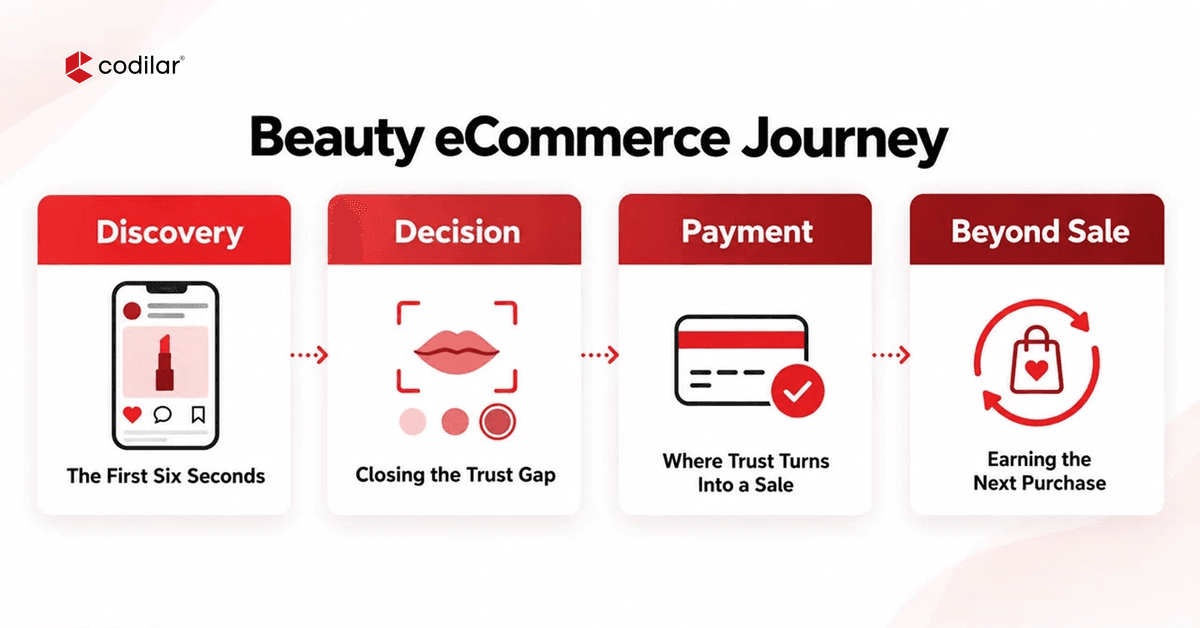
Most beauty traffic in Saudi Arabia arrives from Instagram, TikTok, or a WhatsApp share. A slow homepage or a desktop layout stretched onto a phone breaks that first impression the moment someone clicks through.
Two things matter most here.
Visual merchandising: Beauty is a category people buy with their eyes first, so product photography, color accuracy, and page layout carry more weight than the copy around them.
Arabic-first design: Arabic reads right to left, so a site translated into English-first templates often gets the layout, spacing, and reading flow wrong. Arabic shoppers notice the difference even when they can't say why.
A shopper who cannot test a foundation shade in person needs something else to stand in for that experience. AI-powered shade and skin matching tools, and AR try-on features that let someone preview a lipstick or eyeshadow shade through a phone camera, are two of the more effective substitutes available today.
Trust in a beauty product comes from how it looks on skin and what's actually inside it.
Ingredient transparency: Shoppers increasingly want to know what is in a product before they put it on their skin. In Saudi Arabia, a full ingredient list in the standard INCI format is also a labeling requirement, enforced by the Saudi Food and Drug Authority through its GHAD registration system.
Halal certification: While it isn't legally required for most cosmetic products, it has become a genuine trust signal for Saudi consumers, particularly given cultural sensitivity around alcohol-based and animal-derived ingredients.
User-generated content and reviews add one more layer of trust, giving a hesitant shopper proof from people who already took the risk.
Everything that built trust up to this point comes down to what happens at checkout.
Local payment methods: Saudi shoppers expect to see mada and Apple Pay at checkout, alongside buy-now-pay-later options through Tabby or Tamara. Missing any of these suggests the store wasn't really built for a Saudi customer.
ZATCA compliance: Every VAT-registered business must generate invoices electronically and report or clear them through the Fatoora platform in real time. It has to be built into the checkout from day one.
The payment gateway a brand chooses, commonly HyperPay, Moyasar, or PayTabs in the Saudi market, typically handles both the payment methods and the ZATCA integration together.
In the beauty industry, the second sale is often easier to win than the first, if the brand shows up when the customer runs out.
Reordering and loyalty: A skincare routine or a fragrance runs out and gets reordered, which makes subscription reminders genuinely useful. Loyalty programs that reward repeat purchases work particularly well in a category built on habit.
Returns: Saudi Arabia's eCommerce Law gives shoppers a general right to return most products, but it excludes items that have been opened or used, along with health and personal products.
In practice, an unopened bottle of perfume can usually be returned, while an opened one typically cannot. Brands that state this clearly at the point of purchase build more trust.
Codilar has built and scaled eCommerce experiences for personal care brands across the GCC, including Ajmal Perfumes, one of the region's most recognized fragrance houses.
That work starts from the four stages covered above.
Our team applies these same requirements to any beauty brand entering the Saudi market, regardless of where they're starting from.
The platform choice for a beauty eCommerce website in Saudi Arabia depends on where a brand actually sits, its catalog size, business model, and growth stage.
Shopify Plus is the better platform for a beauty brand with a straightforward catalog and a direct-to-consumer-only model.
Adobe Commerce (Magento) is the better platform for any beauty brand, new or established, whose catalog or business model already demands more than an app-based platform can handle.
A beauty eCommerce website succeeds or fails on how well it replaces the senses a shopper cannot use online. Get this straight, and a website starts doing what a good beauty counter always did: making someone confident enough to buy something they have not yet touched.
Codilar has helped brands build that confidence into their eCommerce experience. So if your brand is entering the Saudi beauty market, contact our team today, and we can help you do the same from the start.
Beauty products rely on senses a website can't reproduce, like touch and how a shade looks on skin. The UX has to substitute for that missing experience through tools like shade matching and AR try-on.
At a minimum, you need to support Mada and a buy now pay later option (Tabby or Tamara), and digital wallets such as Apple Pay. A large proportion of users are on mobile devices in the Kingdom, so it’s critical to have a mobile-friendly checkout.
Shopify Plus is more appropriate for emerging direct-to-consumer (DTC) companies that do not require sophisticated product catalogs. Adobe Commerce is highly scalable and allows for complex catalog management and omnichannel retailing, making it more suitable for established brands with wholesale and B2B distribution networks and a need for enhanced catalog customization. Codilar's team can assess a brand's specific catalog and business model to recommend the right fit.
It depends on what kind of platform you choose to build your site on. A Shopify Plus website with a simple catalog can be built faster than an Adobe Commerce site, which requires more customization and integration. A brand's timeline will depend on the complexity of their catalog, the level of personalization they want (shade matching, AR try-ons), and how much content they need to localize for the Arabic-speaking region.
Cost depends heavily on platform and scope. A Shopify Plus build with a standard catalog costs less upfront than an Adobe Commerce build, which involves deeper customization and integration work. Features like AI shade matching, AR try-on, and Arabic localization add to the cost regardless of platform, so the final number comes down to how much of the customer journey a brand wants built in from launch.

Get tailored technology solutions to scale your retail business online
Request A Quote

Stay ahead with insights, trends, and brand success stories from the world of Digital Commerce.


Level 1, Building 7, Zone A Airport road, Business Gate P.O Box 93597 Riyadh 11683, KSA

DTECH, Techno Hub 1, Dubai Silicon Oasis Authority, United Arab Emirates - Dubai - United Arab Emirates


Codilar Digital Pte Ltd, 68 Circular Road, #02-01, 049422, Singapore

7th Floor, Jupiter Block Prestige Tech Park, Kadubeesanahalli, Bellandur Amtankere, Bengaluru, Karnataka 560103

Satrio Tower, Floor 6, Unit C and D, Desa/Kelurahan Kuningan Timur, Kec Setiabudi, Kota Adm Jakarta Selatan, Provinsi DKI Jakarta
We look forward to hearing from you